 Terry & Nancy's Ancestors
 Gideon Dyer Cobb1,2,3
ID# 1043, (1773 - 1834)
| Father | Elkanah Cobb4 (21 Jan 1746/47 - 10 Aug 1795) |
| Mother | Mary Willard4 (abt 1753 - 2 Aug 1842) |
| Charts | Descendants of Gideon Cobb |
| Ancestry | The Cobbs of Pawlet, Vermont |
Narrative:
Gideon Dyer Cobb was born on 11 Sep 1773 at Stillwater, Albany Co., New York .5,6 He moved to Canterbury, Connecticut, with his parents between 1776 and 1778.10,11
 He moved to Pawlet, Vermont
, with his parents by 1780.12,13,14 He was probably one of the four males over age 16 listed in the household of his father, Elkanah Cobb, in the 1790 Federal Census of Pawlet, Rutland Co., Vermont.15 He moved with his parents to Wells, the next town north of Pawlet, by 1792.16,17 He was named a freeman of Wells on 3 Dec 1794.18
Administrator of His Father's Estate --- Text Stolen from ReigelRidge.com !! ---
Gideon was an administrator for the estate of his father along with his father's brother Ebenezer. They pursued the case Elkanah had filed before his death for damages to his mill. The case came to trial 16 Nov 1795 and the jury found Roger Stevens, Gilbert Soper, Nathaniel Lewis, and John Shumway Jr. guilty and awarded judgment of £60 and costs. The other defendants were acquitted and awarded their costs of trial. In the meantime the administrators filed a second suit for damages to the dam naming 17 defendants, many of them the same as in Elkanah's suit but several new names, including Simon Francis, apparently Elkanah's former partner in the mill. They sought £200 in damages costs. That suit was tried the same day and the jury found all but one of the defendants guilty and awarded £49 in damages and costs. The defendants in both suits filed a motions appealing the decisions to the Vermont Supreme Court claiming that the administrators had no standing to prosecute the suits.19
Gideon married Modena Chittenden Clark, daughter of Gen. Isaac Clark and Hannah Chittenden, about 1796, in or near Castleton, Vermont
.7,8 According to family lore, Modena's family was opposed to her marriage to Gideon because she was so young (about 17), and forbade him from coming to the house. But one day he was out riding and met her taking a walk. He took her up on his horse behind him and they rode into the next county and were married. If so, no record has been found of their marriage in Castleton; no records survive from that period in Fair Haven.20 Gideon and Modena settled in Castleton after their marriage.21 Appeals were to be heard at the 30 Jan 1797 term of the Supreme Court but were not acted upon. The administrators filed a petition with the state Assembly on 20 Sep 1798, asking it to direct the Court to hear and determine the cases as though they had been prosecuted by Elkanah before his death. On 22 Oct 1798 the petition was read to the Assembly, and the petitioners granted leave to withdraw it, with no explanation provided by the record. No record of a decision by the Supreme Court has been found.22,23
On 13 Sep 1799, Gideon and his uncle Ebenezer as administrators exchanged halves of a 16½- acre parcel in Wells next to Pond Brook with James Dunscomb, declaring them to be of equal value.24 The same day they deeded three parcels, "the whole of the real estate of Elkanah Cobb in Wells," to Simon Francis, his former partner. The parcels were of 3 acres, 18 acres, and 50 acres, and excluded the property set off by the court to the widow. The purchase price was $450, the amount by which the debts of the estate exceeded the "moveable estate."25
On 5 Aug 1799 Gideon, as one of the administrators of his father's estate, requested and received authority to sell all his father's real estate in order to pay the estate's debts.26 On 9 Oct 1799 Gideon, as commissioner to sell real estate of his late father, deeded to his mother 21½ acres in Wells, next to the bridge that goes over Pond Brook, as set by order of the probate judge as her dower.27
Gideon acknowledged the last deed before a justice of the peace in Washington Co., New York. Their journey westward may have been already underway, or that may have been closer than getting to Wells.27
The Trek to the Western Frontier --- Text Stolen from ReigelRidge.com !! ---
Gideon and Modena and their young son Caleb were part of a group of over seventy people who moved from Vermont to Kentucky under the leadership of Matthew Lyon. They were part of a small group that made the trek in late 1799, followed by a larger group who arrived in Jun 1801.28,29,30 According to family lore, Modena was a favorite of her aunt, Beulah Chittenden, Lyon's second wife, who she visited many times at the Lyon's home in Fair Haven. Supposedly, that is where that Modena met Gideon. When the Lyons decided to migrate to Kentucky they prevailed upon the young couple to join the party.31
The group traveled in five wagons across the Allegheny Mountains to New Geneva, on the Monongahela River, over 50 miles above Pittsburgh, arriving in mid-Nov 1799. The water was then too low to float down the river, so they spent the winter preparing their boats. New Geneva is not known to have been a common embarkation point, so it seems likely that the location was chosen because of Lyon's association with Albert Gallatin, minority leader of the House of Representatives when Lyon was serving there, who was a resident if that town. Lyon left the party while preparations were underway, returning to his Congressional duties.32,33,34
Lyon left instructions that they were to follow the Ohio River to the mouth of the Cumberland River, then "go up that river until they were suited with regard to the Situation of the country, & the price of Land & there set down." He gave "rather a preference" to Kentucky over Tennessee because he believed land was cheaper there, but gave "them latitude to go up as far as they chuse." The party loaded their flatboats with their goods, including men's and women's saddles, bridles, shoe upper leathers, boots, tin ware, two stills, black smith tools, farming tools, iron, millstones, and grind stones, and set off. They settled at Eddyville, Kentucky
, probably arriving in the spring of 1800.35,36 For details, please see The Trek from Vermont to the Kentucky Wilderness. According to the 1800 census, Eddyville had a population of 69 persons, including 34 free white males, 23 free white females, and 12 slaves. This presumably including the party from Vermont since the official enumeration day was 4 Aug, though we cannot be sure since no copies of the individual schedules survive.37,38 Public Service --- Text Stolen from ReigelRidge.com !! ---
Gideon seems to have taken an active part in his adopted community from the beginning. He was one of the trustees named for the town of Eddyville in the 26 Nov 1800 Livingston Co. Court order that established the town. He was named as a security for the bond of the administrator of an estate in the same court session. On 5 May 1801 he was appointed one of the appraisers for an estate, and also one of two men appointed to select the location for a new ware house. He was appointed security for another estate administrator in Jul 1801. On 6 Jan 1802 he and three others were appointed to mark out a new road from Eddyville to Paitehards Ferry.39
His public service continued for many years. In Sep 1809 he and John Bradley advertised for proposals for the brick work for a brick court house in Eddyville for the new county of Caldwell. At the Nov 1809 term of the Caldwell Co. Court they along with Samuel C. Clark and Elijah George Galusha Jr. posted a bond to build the new court house. In Jul 1818 he was one of five men requested by the county court to view and report on the condition of the road from Eddyville toward Princeton. In the Oct term he was appointed one of four appraisers for the estate of one James Hill. In the Apr1919 term he appointed surveyor of the road from Eddyville to Smithville, commencing at Eddyville to the branch near Dooms old place.40,41 (For more examples, see the extracted County Court Orders.)
Establishing the First Tavern in Eddyville --- Text Stolen from ReigelRidge.com !! ---
Gideon did not waste any time establishing himself in business in the new location either. He opened one of the earliest, if not the first, tavern in Eddyville, obtaining his permit 22 Jul 1800. By one account, it was built of "logs of his own hewing... the only tavern on the then lonesome lower bends of the Cumberland River."42,43 His monoply did not last long, as Enoch Prince obtained a license for a tavern at his home in Eddyville 8 Dec 1801.44 Tavern rates were set by the County Court. In 1800 those rates were:
| whiskey or brandy 12½¢ per half pint | lodging 6¼¢ per night |
| rum, wine and French brandy 25¢ | corn or oats 12½¢ per gallon |
| breakfast or supper 19¢ | horse to hay or fodder 12½¢ |
| dinner 25¢ | pasturage 8½¢ per night.45 |
It appears that Gideon also operated a ferry for a time. On 1 Mar 1802 he obtained a license to operate a ferry at his home on the Cumberland River, and there are references to proposed roads from Cobb's ferry in 1803 and 1804.47
Gideon's first home, and tavern, was located on lot 13 on Water St. in Eddyville, opposite the Cumberland River. He apparently also owned the adjacent lot 33, on 2nd St. No record of his obtaining this property has been found, but the 1801 tax list shows he owned one or more town lots. On 27 Aug 1805 he, in partnership with Samuel C. Clark, bought the adjacent lots 12 and 32, on Water, Franklin, and 2nd Steets48,49(see map.)
Samuel must have moved in with Gideon and his family by 1807. He is assumed to have been some relative of Modena's, but no evidence has been found to indicate what that relationship was.50 On 7 Feb 1809 the two of them obtained a license to operate a tavern in their home, and apparently they operated it jointly. The tavern seems to have been a more welcoming in cold weather than the half-finished courthouse, as the county court for newly formed Caldwell Co. adjourned to there on at least six occasions in the winter months from 1810 through 1815.51,52
Gideon appeared on the 1810 Federal Census of Eddyville, Caldwell Co., Kentucky
, with a household consisting of three white males under age 10 (Robert and Joshua, and apparently Caleb, though he was about 13), and two between 26 and 45 (Gideon, and Samuel Clark, who was listed as co-head-of-household); one female under 10 (Mary) and one between 10 and 15 (unknown), and one between 26 and 45 (his wife, Modena).53,54 On 12 May 1814 Gideon's brother Joshua, of Greene Co., Pennsylvania
, gave their younger brother John a power of attorney to recover debts owed to him by Cobb & Clark. There is no record of what those debts were.55 On 25 Dec 1815 Samuel sold his interest in all four lots to Gideon for $500.56 On 27 Feb 1816, Gideon sold lots 12 and 13, facing Water St. in Eddyville, which included his home and tavern, to his brother John, for $2,200. John obtained a license 22 Apr 1816 to keep a tavern in his home, with Gideon as security for the £100 bond.57,58
Gideon as Tax Collector --- Text Stolen from ReigelRidge.com !! ---
According to his daughter Aurelia's recollections, Gideon had the mail contract between Eddyville and Fort Massac for a time. She related that he often had to carry the mail himself, leaving his wife and young son by themselves or sometimes with a hired man. No other record of his having worked for the Post Office has been found, but he clearly had other Federal service involving Fort Massac. Since this occurred before her birth it seems likely that Aurelia was confused about his role.59
Gideon was commissioned Collector and Inspector of Revenue for the "port and district of Massac" by President Thomas Jefferson in 1805. Because the commission was made to fill a vacant office while the Senate was in recess, the President officially nominated him in a long list of other officials on 20 Dec 1805, shortly after the 9th Congress convened, and he was confirmed 3 Jan 1806.60,61,62 The exact duties of this office have not been learned, but presumably it involved collection of duties on goods imported on the Ohio River. The port of entry of Massac appears to have been located near Fort Massac, on the Ohio River, some 45 miles down-river from Eddyville, then in Indiana Territory and now in Illinois. The district it covered was expanded in 1801, in response to a petition from citizens of Tennessee, to include all of Tennessee, much of Kentucky, and presumably the Territory of Indiana. Given the other activities he is known to have engaged in Eddyville, appears Gideon was not required to spend any significant time at the port.63,64
Gideon was commissioned Surveyor for the "port of Massac" by President Jefferson in 1807, apparently a promotion. Because the commission again was made to fill a vacant office while the Senate was in recess, the President officially nominated him in a long list of other officials on 9 Nov 1807, shortly after the 10th Congress convened, and he was confirmed 18 Nov. He continued to hold that postion until at least 1821, when he was receiving compensation of $150 annually.65,66,67
Gideon's Farm --- Text Stolen from ReigelRidge.com !! ---
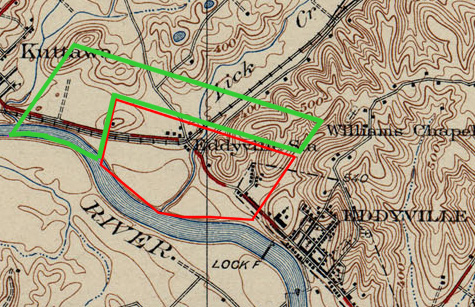
Gideon's 800-acre farm plotted on 1928 topo map
consisting of two 400-acre grants
consisting of two 400-acre grants
On 16 Jul 1816, shortly after he sold his residence and tavern, Gideon was granted patents for two 400-acre parcels on the Cumberland River in Caldwell Co. The family had been certified for a grant of two parcels by the Livingston County Court on 5 Feb 1806, one in his own name and the second in the name of his eight-year-old son Caleb. Just how this was done is curious, since applicants were required to be above the age of 18 and already settled on the parcel. The certificates had lapsed for failure to pay the required installment payments, but the one issued to Caleb was paid up and redeemed 8 Jun 1816 after the legislature provided extensions of time. Gideon allowed his own certificate to lapse and acquired another from Blake Baker for the second 400-acre grant.68,69,70
It is unclear whether Gideon and Modena and family moved to the farm or stayed in town. But it seems clear that Samuel Clark, and possibly one or two of his daughters continued to live with the family after his partnership with Gideon was dissolved. Gideon appeared on the 1820 Federal Census of Eddyville, Caldwell Co., Kentucky
, enumerated 1820 with a household consisting of one white male under age 10 (son Gideon Jr.), two between 10 and 16 (Robert and Joshua), one 19-26 (Caleb), and two over 45 (Gideon and probably Samuel Clark); two white females under age 10 (daughters Hannah and Aurelia), two between 10 and 16 (Mary and another), one between 16 and 26 (unknown), and one over age 45 (probably Modena, but she was only 41). One or both of two unknown girls may have been daughters of the widowed Samuel Clark.71 On 3 Aug 1823 Gideon sold a parcel on the Cumberland River to his son Caleb for $160. This was apparently one of the two 400-acre parcels Gideon obtained in 1816. Caleb began declaring the parcel as his on the tax rolls in 1821, but the deed was apparently not made until later, dated 3 Aug 1823.72,73
Chittenden Lyon wrote in 1828 that Gideon "is reduced in his circumstances in consequence of losing a valuable farm, which was taken by a prior claim after a long law suit, which he had highly improved." Details of that suit have not been found.74 That loss apparently occurred about 1823, as Gideon did not report acreage on the tax rolls after that year.75
Gideon and Modena returned to tavern keeping after losing the farm. His application for a license was delayed in May and August 1825 by a lack of a quorum at the county court, and was finally approved 17 Apr 1826. The license was regularly renewed until at least 1830.76,77 It would seem that the tavern was actually run by Modena. Their daughter recalled, many years later, that she kept a hotel where she boarded the men who built barges.78
Gideon appeared on the 1830 Federal Census of Eddyville, Caldwell Co., Kentucky
, with a household consisting of one white male age 5 to 10 (son Giles), one age 10 to 15 (Gideon Jr.), one 15 to 20 (unknown), seven 20 to 30 (probably Robert and Joshua, and others unknown), and one 50 to 60 (himself); one white female 10 to 15 (daughter Aurelia), two 15 to 20 (Hannah and Persis), and one 30 to 40 (probably Modena, but she was 51); and one female and one male slave. The unknown males were likely permanent guests at the tavern/hotel.79 The Cobb Mercantile Business --- Text Stolen from ReigelRidge.com !! ---
It seems sure that Gideon was engaged in trade from an early date. But exactly how is less clear. His great-grandson, noted humorist Irvin Shrewsbury Cobb, wrote about him:
Almost before the clearings were made he had enrolled himself among that fabulous crew, half-hoss and half-alligator by their own telling—the keelboatmen. On great raftlike "broadhorns" of virgin timbers he loaded the produce of this fecund archipelago—red whisky, already beginning to be known as Bourbon; heavy rank leaf tobacco grown in the so-called Black Patch of western Kentucky and Tennessee; corn, hemp, pelts, hides, pumpkins and hoop-poles, but particularly the whisky and the tobacco—and floated it out to the Ohio and down the Ohio into the Mississippi, past the dens of the river pirates and through hostile Indian country on to the French and Spanish possessions and sold his cargo at New Orleans and broke up his arks for shipbuilding and then rode horseback or walked home again over the Natchez Trace, a more perilous journey even than the water cruise had been.
While Irvin's account is perhaps colored by re-telling by several generations of family, the substance of the trade he describes is consistent with that described by other sources. According to family tradition, Gideon originated the idea of packing tobacco, "leaf, lugs, dirt clods, stalks, stems, trash, and all," into casks and "dousing the mess with crude sorghum molasses and pressing it to sticky solidity." The casks were supposedly shipped to New Orleans, then by sailing ships skippered by distant kinsman from Maine to Africa where they were traded for gold dust and ivory.80,81 Irvin would have us believe that his great-grandfather also founded the retail business that seems to have been the foundation of the next generation's success. Irvin said he had the ledgers and day books from the business, which recorded the sales of "everything from ox-bows and hymn-books, to flintlock muskets, mill wheels and painkillers." He continues that one of the earliest entries records purchases on the proprietor's account in anticipation of the birth of his first son born in Kentucky, in 1804.82
But Gideon never reported owning a store on the tax rolls, and a search of available early newspapers finds no mention of a Cobb store. However, Matthew Lyon, uncle of Gideon's wife and sponsor of the move to Eddyville, did clearly have a store as early as 1802. It seems likely that Gideon was part of Lyon's business, perhaps even managed it since Lyon was occupied in so many other interests, including his service in Congress from 1802 until 1811.83,84,85 Matthew Lyon continued to report his ownership of a store until 1812, and after he transferred his assets to his son Chittenden, who, later in partnership with his brother Matthew Jr., did report ownership of a store. The Cobb name is not associated with the store until 1822, when it is reported by the firm Lyon & Cobb, which according to deeds was composed of Chittenden Lyon and Gideon's son Caleb. So it appears that while Gideon likely had a major role in the mercantile business, he was never an owner.86,87
Other Business Ventures --- Text Stolen from ReigelRidge.com !! ---
Gideon is also known to have owned a mill, a tannery, and carried on a hattery. The hatter was a Negro he owned, but he was stolen or persuaded away, according to his daughter.88
Various accounts have Gideon and Matthew Lyon involved with early iron production in the area. Irvin claims Gideon "was a partner in setting up of the first iron furnace established west of the Allegheny Mountains." Presumably, his account is based on family oral history. He says that his great-grandfather was a metal-worker by trade as his father had been, and benefited from use of the iron ore and coal found on his farm in the furnaces. No contemporary records have been found to document their involvement, but Matthew did accumulate large tracts of land, which would seem to have been of little use other than for iron production. As early as 1803 he reported 3,125 acres on the tax rolls, and some 24 parcels totaling 5,965 acres in 1811.89,90,91
Gideon died on 1 Mar 1834 in Caldwell Co., Kentucky
, at age 60.6,9 He was buried in Riverview Cemetery, Eddyville, Kentucky, in the Cobb family plot.2Children:
Children with Modena Chittenden Clark
Gideon and Modena reportedly had several other children who died in infancy, whose names are not known. If so, no tombstones for them have been found in the Cobb plot in the Eddyville Cemetery.102
 Caleb Clark Cobb92,93 (25 Dec 1797 - 19 Nov 1867)
- Robert Livingston Cobb92,94 (6 Oct 1805 - Jun 1873)
- Mary Willard Cobb92,95 (6 Jul 1807 - Dec 1878)
- Dr. Joshua Cobb96,92,97 (19 Apr 1809 - 7 Apr 1879)
- Hannah Chittenden Cobb92,98 (17 Dec 1811 - 16 Feb 1841)
- Persis Clark Cobb92,99 (23 Nov 1815 - bef 1864)
- Gideon Dyer Cobb Jr.92,99 (3 May 1817 - 10 Dec 1871)
- Aurelia Skinner Cobb100,92 (17 Oct 1819 - 10 Mar 1910)
- Giles Lyon Cobb101 (5 Dec 1820 - 4 Oct 1867)
Citations
- [S862] Births, Marriages and Deaths, Pawlet, Vermont, 1768-1856, pg 5, shows name as Gideon Dyar Cobb.
- [S2092] Gideon D. Cobb grave marker, Eddyville Cemetery.
- [S826] Lyon letter to Witherell, 5 Apr 1828, shows name as G. D. Cobb.
- [S862] Births, Marriages and Deaths, Pawlet, Vermont, 1768-1856, pg 5.
- [S862] Births, Marriages and Deaths, Pawlet, Vermont, 1768-1856, pg 5, shows date, town, and state.
- [S2092] Gideon D. Cobb grave marker, Eddyville Cemetery, shows date.
- [S2529] Ruth Garrett Cobb, "Cobb-Garrett Family History", pg vii, notes of author's daughter, citing 31 Jan 1930 letter from Hallie Cabouise Dobbin to the author, shows married at Castleton.
- [S826] Lyon letter to Witherell, 5 Apr 1828, shows married.
- [S49] Freeman, Family File "David and Deborah.GED," 31 Jul 1998, shows date, town, as Eddyville, county, and state.
- [S862] Births, Marriages and Deaths, Pawlet, Vermont, 1768-1856, pg 5, shows Joshua as born at Stillwater in May 1776, and Sarah born in Canterbury in Jul 1778.
- [S2275] Sylvester, History of Saratoga County, pg 289, shows that many families returned to Connecticut for safety during the most dangerous period of the war.
- [S1171] Hollister, Pawlet for One Hundred Years, pg 178, shows Gideon was one of the earliest settlers from Connecticut; pg 40 shows he was a selectman in 1780; pg 39 shows John was a constable in 1780; and pg 179, shows Elkanah moved from Connecticut in 1770 [so apparently he and his wife returned there after their time in Saratoga and Connecticut].
- [S862] Births, Marriages and Deaths, Pawlet, Vermont, 1768-1856, pg 5, shows Elkanah's son Willard was born in Pawlet 17 Mar 1781; pg 32 shows Ebenezer's son Darick was born in Pawlet 11 Mar 1780; and pg 85 shows Joshua was married in Pawlet 17 Sep 1781.
- [S2267] Land Records, Pawlet, Vermont, 1:266-7, John Fassett, commissioner for the state of confiscated land to Ebenezer Cobb of Stillwater, Albany Co., New York, dated 9 Nov 1779; 1:69-70, John Clark to John Cobb of Canterbury, Windham Co., Conicticut [sic], dated 9 Nov 1778; 1:171, Peter Van Baurer to Joshua Cobb of Stillwater, Albany Co. dated 4 Feb 1780; 1:271-2, Joel Simonds to Joshua Cobb of Pawlett, dated 19 Sep 1781; 1:275-6, Ebenazer Cobb of Pawlett to Joshua Cobb of Pawlett, dated 20 Sep 1781; 2:37, Benjamin Petton to Elkanah Cobb of Pawlett, dated 18 Dec 1783; and 2:65, Nathan Niles to John Cobb of Pawlett, dated 27 Oct 1784.
- [S1781] Elkanah Cobb household, 1790 U.S. Census, Rutland Co., Vermont.
- [S2395] Land Records, Wells, Vermont, C:272-3, notes of town meeting 6 Mar 1792 at the schoolhouse near Nathan Warram and meeting of authority & selectmen afterwards for the appointment of tavern or houses of intertainment, shows Elkanah nominated for license; C:425, town meeting 14 Feb 1793 at schoolhouse near Elkanah Cobbs does not mention tavern license; notes for 1794 meeting not found; B:423 notes of town meeting 10 Mar 1795 held at school house near Elkanah Cobb's, and meeting of authority afterwards for the appointment of tavern or houses of intertainment, shows Elkanah nominated for tavern license.
- [S863] Cobb, History of the Cobb Family, pg 154, shows that in probate proceedings he is called "Elkanah Cobb late of Wells.
- [S2395] Land Records, Wells, Vermont, B:104, record of freeman 1783-1797.
- [S7906] Old Supreme Court Files Nos. 3222 to 3415, Rutland, Vermont, folder 211, paper 3287, copy of County Court record in Elkanah Cobb vs. Abner Cone et al.; paper 3287, copy of County Court record in Ebenezer Cobb & Gideon D. Cobb vs. Abner Cone et al.; and paper 3288, a second copy of County Court record in Elkanah Cobb vs. Abner Cone et al.
- [S2529] Ruth Garrett Cobb, "Cobb-Garrett Family History", pg 4, gives story of their marriage.
- [S2269] "To Be Sold," The Vermont Gazette, 29 Aug 1799, shows his address as Castleton.
- [S2377] Ebn Cobb and Gideon D. Cobb to General Assembly of State of Vermont, petition, 20 Sep 1798, State Archives & Records Administration, recites history of prior proceedings.
- [S2381] State Papers of Vermont, vol 11, General Petitions 1797-1799 (1962), pp 208-10, contains transcript of petition; vol 3 part 8, Journals and Proceedings of the General Assembly of the State of Vermont 1797-1799 (1978), pg 295, shows dispostion.
- [S2395] Land Records, Wells, Vermont, D:386, Gideon D. and Ebenezer Cobb, administrators, to James Dunscomb, 8 Oct 1799; and D:367, James Dunscomb to Gideon D. and Ebenezer Cobb, administrators, same date.
- [S2395] Land Records, Wells, Vermont, D:386-7, Gideon D. Cobb to Simon Francis, 28 Nov 1799.
- [S2396] Probate Records , vol 3 pp 95-6.
- [S2395] Land Records, Wells, Vermont, D:373, Gideon D. Cobb, commissioner, to Mary Cobb, 12 Nov 1799.
- [S2388] Matthew Lyon letter to Jackson, 28 Feb 1800, Lyon says he took with him one of his daughters and her husband, an unmarried daughter, a niece and her husband [Modena and Gideon] and several adventurers, and he intended to later bring his wife and family and others.
- [S1977] Cobb, Exit Laughing, pg 21, shows his great-grandfather "assembled his brood" in 1799 as part of nine-month trek overland, then by barge from Pittsburgh, by12 families, led by Matthew Lyon.
- [S2384] Matthew Lyon letter to Jefferson, 4 Apr 1801, 6th page, shows within a few days he would start for western waters, but expected to be detained a week or two at N Genevea before proceeding to the Cumberland River.
- [S2529] Ruth Garrett Cobb, "Cobb-Garrett Family History", pg 4, citing "another account."
- [S2388] Matthew Lyon letter to Jackson, 28 Feb 1800, shows he had five teams, arrival in New Geneva, and his departure.
- [S2308] Ruth Cobb letter to Irvin S. Cobb, 29 Aug 1931, pg 10, shows the party traveled by covered wagon across the Allegenys to Pittsburg, then by flatboat to the Cumberland.
- [S1265] Wikipedia, online, article "Albert Gallatin," viewed 17 Jul 2008, shows Gallatin became a member of the House in 1795, and became minority leader as an important member of the Democratic-Republican Party before being appointed Secretary of the Treasury by Jefferson.
- [S2388] Matthew Lyon letter to Jackson, 28 Feb 1800.
- [S1970] Livingston Co. Order Book, A:47, 22 Jul 1800, shows Gideon D. Cobb permitted to keep tavern at his own house in the town of Eddyville, demonstrating that he has established a home there before that.
- [S3051] Return of the Second Census, pg 66, shows populations.
- [S3050] Ancestry.com, online, "About 1800 United States Federal Census," shows enumeration date and that the schedules for Kentucky have not survived.
- [S1970] Livingston Co. Order Book, A:58, 25 Nov 1800, town of Eddyville established with Gideon D. Cobb as one of the initial trustees; pg 60, George Davenport appointed administrator for Michael Doherter, decd., Gideon D Cobb & John Pounds his security for bond of $300; pg 89, 5 May 1801, Charles Stewart, John Prince, John Pounds, Elijah G Galusha & Gideon Cobb to appraise estate of James Davenport, decd., and Charles Stewart & Gideon D Cobb appointed to point out and designate the lot of ground on which the ware house is to be built in Eddyville; pg 100, 7 Jul 1801, David Caldwell appointed administrator of James Davinport, decd., in room of Mary Davinport who is now decd.; William C Rodgers, Gideon D Cobb & William Dobbins as securities for $5000 bond; and pg 150, 6 Jan 1802, Gideon D Cobb, David Caldwell, Jacob Doom & James Berry appointed to view and mark a road from this place to Paitehards ferry.
- [S3198] "Eddyville Court-House," The Farmer's Friend, 2 Oct 1809.
- [S1971] Caldwell Co. Order Book, 1:49-50, 7 Nov 1809, John Bradley, Gideon D. Cobb, Saml C. Clark and Elijah G. Galusha bond for brick court house; C:10, 28 Jul 1818, order for G. D. Cobb and four others to view road and report; C:43, Nov 1818, Gideon D. Cobb, Saml. C. Clark, and three others to return inventory of estate of Jas. Hill; and C:83, 26 Apr 1819, Gideon D. Cobb appointed surveyor.
- [S1970] Livingston Co. Order Book, A:6 and 8, 23 Jul 1799, John McElmurry and James Ritchey granted license for taverns in their homes, but they seem to have been in Salem and Smithland respectively, accoring to 1810 census entries; and A:47, 22 Jul 1800, Gideon D Cobb permitted to keep tavern at his own house in the town of Eddyville for a year; B, 3 Jul 1804 and B, 7 Aug 1805, license renewed.
- [S1977] Cobb, Exit Laughing, pg 24.
- [S1970] Livingston Co. Order Book, A:141.
- [S1970] Livingston Co. Order Book, A:49-50, 23 Jul 1800.
- [S2386] Clark, "Diary," pg 194.
- [S1970] Livingston Co. Order Book, A:161, ferry license; A:201, 3 Jan 1803 report of viewer of road from Cobbs ferry to mouth of Cumberland; B, 4 Jul 1804, Hery Doom appointed to survey road to Cobbs ferry from Eddyville; and B 3 Dec 1804, several appointed to view road from Wm Prince's to Cobbs ferry.
- [S4054] Livingston Co. tax lists,, 1801, pg 9, shows value of town lots as 200.
- [S1975] Deeds, Caldwell Co., Kentucky, A:587-9, David Walker & wife to Gideon D Cobb & Samuel C Clark, replacing original deed since lost, 11 Jun 1813.
- [S4054] Livingston Co. tax lists,, 1807, pg 6, shows person charged with tax as "Clark & Cobb," with two white males over age 21; shown as "Cobb & Clark" at 1808 pg 7 and 1809 pg 5.
- [S1970] Livingston Co. Order Book, D:7, Feb 1809, license issued to Cobb and Clark for tavern in their house.
- [S1971] Caldwell Co. Order Book, 1:84, 7 May 1810, Cobb and Clark permitted to keep a tavern; renewed at 1:254, 7 Dec 1812 and 1:357-8, 28 Nov 1814; Court adjourned to Cobb & Clark house at 1:55, 1 Jan 1810, 1:64, 5 Feb 1810, 1:71, 5 Mar 1810, 1:309, 23 Nov 1813, 1:314, 24 Jan 1814, and 1:360, 23 Jan 1815.
- [S583] Cobb & Clarke household, 1810 U.S. Census, Caldwell Co., Kentucky.
- [S826] Lyon letter to Witherell, 5 Apr 1828, shows that Samuel C. Clark was living with G. D. Cobb in 1828.
- [S1975] Deeds, Caldwell Co., Kentucky, B:9-10, 25 Jun 1814.
- [S1975] Deeds, Caldwell Co., Kentucky, B:198-9, Samuel C. Clark to Gideon D. Cobb, 28 Feb 1816.
- [S1975] Deeds, Caldwell Co., Kentucky, B:164-5, 28 Feb 1816.
- [S1971] Caldwell Co. Order Book, B:35, 22 Apr 1816.
- [S2529] Ruth Garrett Cobb, "Cobb-Garrett Family History", pg 6.
- [S2718] Journal of Executive Proceedings of the Senate, vol 2, pp 7-9, 20 Dec 1805, nominations, including that of "Gideon D. Cobb of Indiana," received by Senate; pg 10, 23 Dec, referred some of the nominations, including Gideon's, to committee; and pg 13, 3 Jan 1806, approved some of those nominations, including Gideon's.
- [S2212] Journal of the Senate, 8th Congress, 2nd session, pg 474, 5 Mar 1805, Senate adjourned; and 9th Congress, 1st session, pg 3, 2 Dec 1805, session commenced.
- [S4044] A Register of the United States 1816, pg 25, shows him as surveyor at Massac, Illinois.
- [S2211] Journal of the House of Representatives, 6th Congress, 2nd session, pg 747, 30 Dec 1800, petition to replace the port of entry at Palmyra, Tennessee with one at Ft. Massac or elsewhere below the mouth of the Cumberland; pg 785, 4 Feb 1801, bill introduced to close districts of Palmyra and Louisville and expand Massac; and pg 843, 3 Mar 1801, message received that the President had signed the bill on the 2nd.
- [S2719] Annals of Congress, 6th Congress, pg 1556, text of bill bill approved 2 Mar 1801, shows "District of Massac, in addition to the territory it already possesses, shall include all waters, shores, and inlets, now included within the District of Palmyra, and all rivers, waters, shores and inlets, lying within the State of Tennessee," and amending the "Act to regulate the collection of duties on imports and tonnage" to close the district of Palmyra.
- [S2718] Journal of Executive Proceedings of the Senate, vol 2, pp 56-7, 9 Nov 1807, nominations, including that of "Gideon D. Cobb of Indiana Territory," received by Senate; pp 58-59, 12 Nov, referred some of the nominations, including Gideon's, to committee; 18 Nov, approved most of those nominations, including Gideon's.
- [S2212] Journal of the Senate, 9th Congress, 2nd session, pg 178, 3 Mar 1807, Senate adjourned; and 10th Congress, 1st session, pg 185, 26 Oct 1807, session commenced.
- [S7935] A Register of the United States 1821, pg 47, shows him as surveyor at Massac, and compensation.
- [S4597] Cobb, patent file, 16 Jul 1816, Kentucky Secretary of State, Land Office.
- [S4056] Cobb, patent file, 16 Jul 1816, Kentucky Secretary of State, Land Office.
- [S4059] Littell, The Statute Law of Kentucky, vol II, pg 420, provides text of authorizing act.
- [S576] Gideon D. Cobb household, 1820 U.S. Census, Caldwell Co., Kentucky.
- [S1975] Deeds, Caldwell Co., Kentucky, D:234, Gideon D. Cobb to Caleb C. Cobb, 1 Jul 1824.
- [S4057] Caldwell Co. tax lists,, 1821, pg 10; 1822, pg 5, et seq.
- [S826] Lyon letter to Witherell, 5 Apr 1828.
- [S4057] Caldwell Co. tax lists,, 1822, pg 5, Gideon reported 300 ac.; 1823 pg 10 he reported 250 ac.; 1828 pg 8, reported no acreage, nor any after than until 1829.
- [S1971] Caldwell Co. Order Book, D:226, 17 Apr 1826, Gideon D. Cobb granted license for tavern at Eddyville after three continuances for lack of a majority; renewed D:361, 21 Apr 1828; D:425, 20 Apr 1829; and E1:55, 19 Apr 1830 (record not searched thereafter).
- [S4057] Caldwell Co. tax lists,, 1827 pg 7, 1828 pg 57, 1839 pg 10 all show a tavern license.
- [S2308] Ruth Cobb letter to Irvin S. Cobb, 29 Aug 1931, pp 16-7, quoting Aurelia (Cobb) Kirkpatrick's response to an 1881 questionnaire sent her by her nephew Major Robert Cobb, son of her brother.
- [S1789] Gideon Cobb household, 1830 U.S. Census, Caldwell Co., Kentucky.
- [S1977] Cobb, Exit Laughing, pg 23, and footnote pp 24-5.
- [S1007] Roe, Aunt Leanna, pg 171, in an undated anecdote, estimated at about 1810 by its place in the narrative, notes that Mr. Cobb is about to start for New Orleans.
- [S1977] Cobb, Exit Laughing, pp 24-5.
- [S1007] Roe, Aunt Leanna, pg 29, shows neighbors from Eddy Grove visiting Lyon's store at an unspecified early date; and pg 64, quotes Mr. Baker as refering to Lyon as the store-keeper.
- [S4054] Livingston Co. tax lists,, 1802 - 1809, no listing for Gideon Cobb shows a store; 1802 pg 8, 1808 pg 20, and 1809 pg 20 all show a Lyon with a retail store.
- [S4058] "Deer Skins Wanted," The Farmer's Friend, 2 Oct 1809, notice for "M Lyons Store" in Eddyville.
- [S4057] Caldwell Co. tax lists,, 1812 pg 24, Matthew Lyon reported a store; 1813 pp 23-4, Chittenden Lyon reported all the lands previously reported by Matthew and the store; 1816 pg 25, 1817 pg 23, and 1818 pg 23, C & M Lyon Jnr report a store; and 1822 pg 24 Lyon & Cobb report a store.
- [S1975] Deeds, Caldwell Co., Kentucky, E:141-2, grantee is Chittenden Lyon & Caleb C. Cobb "partners in trade and known by the style and firm of Lyon & Cobb," 13 Nov 1826.
- [S2308] Ruth Cobb letter to Irvin S. Cobb, 29 Aug 1931, pg 16, quoting Aurelia (Cobb) Kirkpatrick's response to an 1881 questionnaire sent her by her nephew Major Robert Cobb, son of her brother.
- [S1977] Cobb, Exit Laughing, pg 23.
- [S4054] Livingston Co. tax lists,, 1803, pp 1-2.
- [S4057] Caldwell Co. tax lists,, 1811, pg 26.
- [S2303] Kilbury-Cobb, "RE: Cobb Ancestry," e-mail to author, 15 Jun 2001, citing hand-written pages titled "From Joshua Cobb's Family Bible," provided by Lillian W. Sprout, 5 Dec 1931, Montrose, Pennsylvania.
- [S2529] Ruth Garrett Cobb, "Cobb-Garrett Family History", pg 5.
- [S1042] Connelley and Coulter, History of Kentucky, pg 497.
- [S1289] Register of Deaths, Commonwealth of Kentucky, 1878, Caldwell Co., Clark, Mary W, shows parents as G & M Cobb.
- [S1012] Cobb, USMA Cadet Application Papers, 13 Feb 1828 letter from G. D. Cobb to Congressman C. Lyon, authorizing the Congressman to sign his name "to any instrument of writing that may be necessary to show my approbation as it ____ my son Joshua Cobb getting the appointment as cadet to West Point;" 19 Mar 1828 letter signed by Chittenden Lyon for G D. Cobb giving his assent "that his son Joshua Cobb" may sign papers binding him to military service upon graduation.
- [S1352] The National Cyclopaedia of American Biography, pg 214.
- [S732] Caldwell Co. Marriage Records, loose papers, bond of John Hallick and John B. Craig, 8 Sep 1830, has statement by clerk that J. B. Craig made an oath that "old G. D. Cobb the father of Hannah" was willing for the match to proceed.
- [S2793] Deeds, Crittenden Co., Kentucky, B:893-4, Gideon D. Cobb to Persus C. Marshall & her children John C. Marshall, Edwin M. Marshall, Ellen A. Marshall, Gideon D. Marshall, Henry B. Marshall, Mary E. Marshall & Charles U. Marshall, 15 Dec 1851, grantor states that Persus was his sister.
- [S4543] Battle, Perrin and Kniffin, Kentucky - A History of the State, pg 705.
- [S2303] Kilbury-Cobb, "RE: Cobb Ancestry," e-mail to author, 15 Jun 2001, citing hand-written pages titled "From Joshua Cobb's Family Bible," provided by Lillian W. Sprout, 5 Dec 1931, Montrose, Pennsylvania, shows date.
- [S2529] Ruth Garrett Cobb, "Cobb-Garrett Family History", pg 5, shows that several children died in infancy, and names the nine that survived to adulthood.
